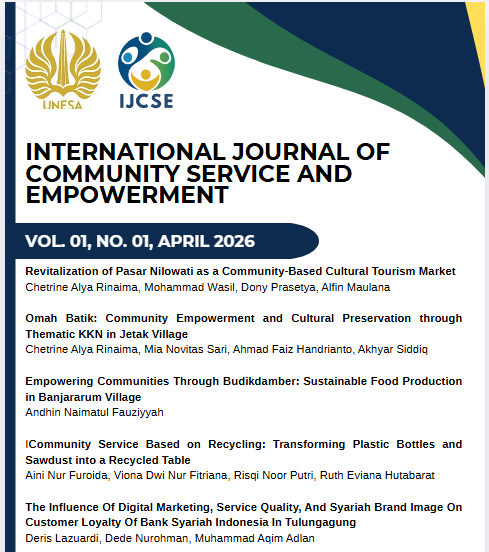
Omah Batik: Community Empowerment and Cultural Preservation through Thematic KKN in Jetak Village
Keywords:
Thematic KKN, Community Empowerment, Creative Economy, Community participationAbstract
The implementation of the Thematic Community Service Program (KKN) in Jetak Village focused on developing local potential through the Omah Batik program. This initiative aimed to empower the community by providing skills training, including eco-print on tote bags, tie-dye techniques, and Tengger Udeng Batik production. The methodology included preparation stages, direct hands-on training, and guidance for residents throughout the batik production process, followed by an exhibition of the works as a medium for promotion and education. These activities not only enhanced practical skills but also raised awareness of the importance of preserving local cultural heritage. The training results were displayed in the Tengger Udeng Batik exhibition at Omah Batik, serving as a platform for community recognition as well as promotion of the village’s creative products to a wider audience. The impact of the program was observed in several aspects: economically, by opening new market opportunities and supporting the development of local MSMEs; socially, by strengthening community cohesion and self-confidence; and culturally, by reinforcing the unique identity of Jetak Village. Thus, Omah Batik functions as an educational center, a cultural preservation hub, and a driver for sustainable creative economic development. The program’s continuity is essential to ensure long-term benefits for the residents of Jetak Village.
Downloads
References
Adinugraha, H. H., Al Masobih, I., Nafiyah, I., & Anas, A. (2024). Community
Empowerment in Kebanggan Village: Asset-Based Community-Driven
Development (ABCD) Approach. IKHLAS: Jurnal Pengabdian Dosen Dan
Mahasiswa, 3(1), 58–65. hmps://doi.org/10.58707/ikhlas.v3i1.994
Ahmad, I., & Islam, M. R. (2024). The Fabric of Society: Understanding
Community Development. In Building Strong Communities: Ethical
Approaches to Inclusive Development (pp. 1–26). Emerald Publishing Limited.
hmps://doi.org/10.1108/978-1-83549-174-420241001
Aquino, R. S., Lück, M., & Schänzel, H. A. (2018). A conceptual framework of
tourism social entrepreneurship for sustainable community development.
Journal of Hospitality and Tourism Management, 37, 23–32.
hmps://doi.org/10.1016/j.jhtm.2018.09.001
Berliani, N. T., Nainggolan, U. F., Raissa, V. I., Sylvi, N. A., Talita, A. C., &
Armanda, R. P. (2023). TOURISM PLANNING THROUGH CULTURAL
HERITAGE AND LOCAL WISDOM IN BROMO TENGGER SEMERU
NATIONAL PARK: A HISTORICAL PERSPECTIVE. HISTORIA; Jurnal
Pendidik Dan Peneliti Sejarah, 6(1), 108–119.
Chandra, S. (2023). Documentation of the plants used in different Hindu rituals
in Umarakhand, India. Asian Journal of Ethnobiology, 5(2).
hmps://doi.org/10.13057/asianjethnobiol/y050203
Muluk, M. R. K., Novita, A. A., & Wiswayana, W. M. (2025). Collaborative
Strategies for Community Empowerment: A Narrative Study on Thematic
Village Development in Malang, Indonesia. Journal of Contemporary
Governance and Public Policy, 6(1), 23–38.
hmps://doi.org/10.46507/jcgpp.v6i1.649
Naji, K. K., Gunduz, M., & Al-Qahtani, A. (2024). Unveiling Digital
Transformation: Analyzing Building Facility Management’s Preparedness
for Transformation Using Structural Equation Modeling. Buildings, 14(9),
2794. hmps://doi.org/10.3390/buildings14092794
Nursanty, E., & Wulandari, A. (2023). UNVEILING THE AUTHENTICITY OF
ISLAMIC VALUES: THE EVOLUTION AND TRANSFORMATION OF
TRADITIONAL VILLAGES. Journal of Islamic Architecture, 7(4), 595–612.
hmps://doi.org/10.18860/jia.v7i4.21258
Permatasari, P., Ilman, A. S., Tilt, C. A., Lestari, D., Islam, S., Tenrini, R. H.,
Rahman, A. B., Samosir, A. P., & Wardhana, I. W. (2021). The Village Fund
Program in Indonesia: Measuring the Effectiveness and Alignment to
Sustainable Development Goals. Sustainability, 13(21), 12294.
hmps://doi.org/10.3390/su132112294
Rafii, A. I., Sarmini, S., Prasetya, S. P., & Chanthoeurn, D. (2023). Local Cultural
Wisdom of Natural Disaster-Prone Communities in Probolinggo,
Indonesia (Socio-Religious Perspective). International Journal Ihya’ ’Ulum
al-Din, 25(1), 49–60. hmps://doi.org/10.21580/ihya.25.1.16171
Sodik, J., Purwiyanta, P., & Wijayanti, D. L. (2021). Village Economic Potential
for The Implementation of Learning Building Village / KKN Thematic
MBKM Program Economic Study Program Development Department of
Economics, Faculty of Economics and Business of The UPN “Veteran”
Yogyakarta. RSF Conference Series: Business, Management and Social Sciences,
1(3), 179–184. hmps://doi.org/10.31098/bmss.v1i3.317
Suardana, I. W., Gelgel, I. P., & Watra, I. W. (2022). Traditional villages
empowerment in local wisdom preservation towards cultural tourism
development. International Journal of Social Sciences, 5(1), 74–81.
hmps://doi.org/10.21744/ijss.v5n1.1876
Sukmawan, S., Sucipto, S., & Tawaka, G. T. I. (2025). Indulging the Taste Buds,
Enjoying Pujan Kasanga: Developing Halal Gastronomic Tourism Based
on Local Cultural Institutionalization. Journal of Community Services and
Engagement: Voice of Community (VOC), 4(2), 1–11.
hmps://doi.org/10.23917/voc.v4i2.5430
Wang, C. (2019). Building a Network for Preserving Intangible Cultural
Heritage through Education: A Study of Indonesian Batik. International Journal of Art & Design Education, 38(2), 398–415.
hmps://doi.org/10.1111/jade.12200
Widagdo, A. K., Purnomo, R. A., Jaafar, N. I., Amperawati, E. D., Arifah, S., &
Tajudeen, F. P. I. (2017). Formulation of a Trade-oriented Indonesian Position
on the Protection of Traditional Cultural Expression (TCEs) A Case Study of
Indonesian Batik as Indonesia Enters theASEAN Economic Community.
UNIVERSITY OF SYDNEY .
Widiyanto, W., Rusdiyana, E., Lestary, E., Setyowati, R., Anggraini, N., &
Sugihardjo, S. (2025). The implementation of climate village program
(Proklim) through Student Community Service (KKN): an action research.
IOP Conference Series: Earth and Environmental Science, 1518(1), 012025.
hmps://doi.org/10.1088/1755-1315/1518/1/012025
Downloads
Published
How to Cite
Issue
Section
 Abstract views: 37
,
Abstract views: 37
, PDF Downloads: 41