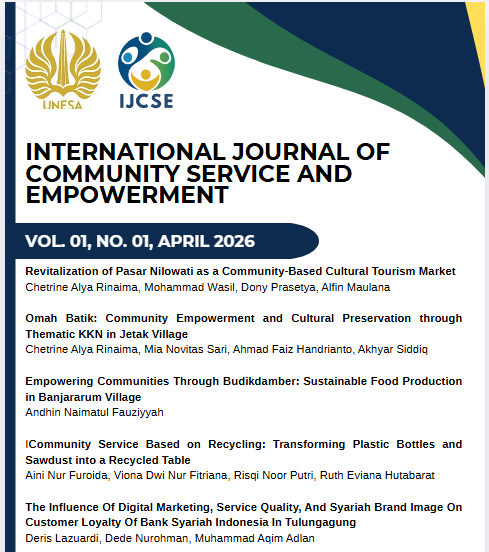
Empowering Communities Through Budikdamber: Sustainable Food Production in Banjararum Village
Keywords:
Budikdamber, urban agriculture, community empowerment, food security, sustainable developmentAbstract
Urban and peri-urban areas in Indonesia face challenges in food production due to shrinking agricultural land from residential and industrial expansion. Banjararum Village, Singosari District, Malang Regency, represents a community with strong local agricultural potential, particularly in mustard and pakcoy cultivation. This study reports on a community service program introducing Budikdamber (fish cultivation in buckets) to enhance household food security. The program involved socialization, hands-on demonstrations, and interactive discussions with members of the Women Farmers Group and Brassican youth. Participants actively engaged in the sessions, asking questions about fish species, water management, and nutrient supplementation, and successfully practiced preparing media, planting seedlings, and transferring acclimatized fish into buckets. Budikdamber proved to be a simple, cost-effective, and space-efficient system, allowing dual harvests of vegetables in approximately 30 days and fish in around 90 days. The program improved participants’ knowledge and skills, strengthened community empowerment, and promoted sustainable food production. This approach aligns with Sustainable Development Goals, particularly in achieving food security and improving health and well-being. The findings indicate that Budikdamber is a practical, scalable, and sustainable model for small-scale households facing limited land availability, offering opportunities for innovation, economic development, and increased local resilience.
Downloads
References
• Aquino, R. S., Lück, M., & Schänzel, H. A. (2018). A conceptual framework of tourism social entrepreneurship for sustainable community development. Journal of Hospitality and Tourism Management, 37, 23–32. hjps://doi.org/10.1016/j.jhtm.2018.09.001
• Berliani, N. T., Nainggolan, U. F., Raissa, V. I., Sylvi, N. A., Talita, A. C., & Armanda, R. P. (2023). TOURISM PLANNING THROUGH CULTURAL HERITAGE AND LOCAL WISDOM IN BROMO TENGGER SEMERU NATIONAL PARK: A HISTORICAL PERSPECTIVE. HISTORIA; Jurnal Pendidik Dan Peneliti Sejarah, 6(1), 108–119.
• Chandra, S. (2023). Documentation of the plants used in different Hindu rituals in Ujarakhand, India. Asian Journal of Ethnobiology, 5(2). hjps://doi.org/10.13057/asianjethnobiol/y050203
• Hesti, M., & Valeria, M. (2024). Exploring the Efficacy of Student Community Service Programs (KKN) in Higher Education Institutions: A Case Study in Indonesia. Unideb, 12(1).
• Muluk, M. R. K., Novita, A. A., & Wiswayana, W. M. (2025). Collaborative Strategies for Community Empowerment: A Narrative Study on Thematic Village Development in Malang, Indonesia. Journal of Contemporary Governance and Public Policy, 6(1), 23–38. hjps://doi.org/10.46507/jcgpp.v6i1.649
• Naji, K. K., Gunduz, M., & Al-Qahtani, A. (2024). Unveiling Digital Transformation: Analyzing Building Facility Management’s Preparedness for Transformation Using Structural Equation Modeling. Buildings, 14(9), 2794. hjps://doi.org/10.3390/buildings14092794
• Nursanty, E., & Wulandari, A. (2023). UNVEILING THE AUTHENTICITY OF ISLAMIC VALUES: THE EVOLUTION AND TRANSFORMATION OF TRADITIONAL VILLAGES. Journal of Islamic Architecture, 7(4), 595–612. hjps://doi.org/10.18860/jia.v7i4.21258
• Permatasari, P., Ilman, A. S., Tilt, C. A., Lestari, D., Islam, S., Tenrini, R. H., Rahman, A. B., Samosir, A. P., & Wardhana, I. W. (2021). The Village Fund Program in Indonesia: Measuring the Effectiveness and Alignment to Sustainable Development Goals. Sustainability, 13(21), 12294. hjps://doi.org/10.3390/su132112294
• Rafii, A. I., Sarmini, S., Prasetya, S. P., & Chanthoeurn, D. (2023). Local Cultural Wisdom of Natural Disaster-Prone Communities in Probolinggo, Indonesia (Socio-Religious Perspective). International Journal Ihya’ ’Ulum al-Din, 25(1), 49–60. hjps://doi.org/10.21580/ihya.25.1.16171
• Sukmawan, S., Sucipto, S., & Tawaka, G. T. I. (2025). Indulging the Taste Buds, Enjoying Pujan Kasanga: Developing Halal Gastronomic Tourism Based on Local Cultural Institutionalization. Journal of Community Services and Engagement: Voice of Community (VOC), 4(2), 1–11. hjps://doi.org/10.23917/voc.v4i2.5430
• Wang, C. (2019). Building a Network for Preserving Intangible Cultural Heritage through Education: A Study of Indonesian Batik. International Journal of Art & Design Education, 38(2), 398–415. hjps://doi.org/10.1111/jade.12200
• Widagdo, A. K., Purnomo, R. A., Jaafar, N. I., Amperawati, E. D., Arifah, S., & Tajudeen, F. P. I. (2017). Formulation of a Trade-oriented Indonesian Position on the Protection of Traditional Cultural Expression (TCEs) A Case Study of Indonesian Batik as Indonesia Enters theASEAN Economic Community. UNIVERSITY OF SYDNEY .
• Widiyanto, W., Rusdiyana, E., Lestary, E., Setyowati, R., Anggraini, N., & Sugihardjo, S. (2025). The implementation of climate village program (Proklim) through Student Community Service (KKN): an action research. IOP Conference Series: Earth and Environmental Science, 1518(1), 012025. hjps://doi.org/10.1088/1755-1315/1518/1/012025
Downloads
Published
How to Cite
Issue
Section
 Abstract views: 24
,
Abstract views: 24
, PDF Downloads: 30