Optimasi Pengendalian PID pada Load Frequency Control Menggunakan Artificial Hummingbird Algorithm
DOI:
https://doi.org/10.26740/jte.v15n3.p238-248Keywords:
Load Frequency Control, PID control, frequency stability, Artificial Hummingbird Algorithm, ITAE, OptimizationAbstract
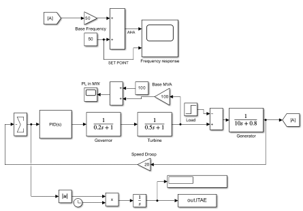
Load Frequency Control (LFC) is an important part of the electrical power system that functions to maintain frequency stability when load changes occur. Frequency instability can reduce system reliability and disrupt the performance of connected equipment. One common method to improve system stability is to use a Proportional-Integral-Derivative (PID) controller. However, conventional PID parameter tuning often fails to produce optimal performance. This study aims to optimize PID control parameters using the Artificial Hummingbird Algorithm (AHA), a metaheuristic algorithm inspired by the flight and foraging behavior of hummingbirds. The implementation was carried out using MATLAB with the Integral of Time-weighted Absolute Error (ITAE) objective function to minimize system errors. The AHA algorithm was modified to display the evolution of fitness values and convergence to the optimal solution during the iteration process. The simulation results show that the PID controller optimized with AHA is capable of producing a faster system response, has lower Overshoot, and achieves a more stable condition compared to conventional methods. These findings prove that the Artificial Hummingbird Algorithm is an effective and efficient optimization method for tuning PID control parameters in Load Frequency Control systems.
Downloads
References
Dev, A., Bhatt, K., Mondal, B., Kumar, V., & Kumar, V. (2024). Enhancing load frequency control and automatic voltage regulation in Interconnected power systems using the Walrus optimization algorithm.
Jangid, P. (2025). Design a PID controller based on grey wolf optimization algorithm for single-area load frequency control. 3(1), 1–8.
Kamarudin, M. N., Shaharudin, N., Haqkimi, N., & Rahman, A. (2021). Review on load frequency control for power system stability. 19(2), 638–644. https://doi.org/10.12928/TELKOMNIKA.v19i2.16118
Ogata, K. (2009). Modern Control Engineering.
Rasolomampionona, D. D., Połecki, M., Zagrajek, K., Wróblewski, W., & Januszewski, M. (2024). A Comprehensive Review of Load Frequency Control Technologies. Energies , 17(12). https://doi.org/10.3390/en17122915
Ravikumar, B., Ashok, G., & Sivaprasad, B. (2015). Tuning PID Controller Parameters for Load Frequency Control Considering System Uncertainties. 5(5), 42–47.
Vijay Kumar, A., & Ranga Reddy, G. P. (2024). Prototype Of Fuzzy PID Controller For Load Frequency Control Based On Hybrid Optimization Algorithm. Ispes 2023, 38–44. https://doi.org/10.5220/0012506000003808
Downloads
Published
How to Cite
Issue
Section
 Abstract views: 90
,
Abstract views: 90
, PDF Downloads: 89