ANALISIS GANGGUAN FASA KE TANAH PADA SISTEM ELECTRICAL SUBMERSIBLE PUMP TIGA FASA DI SUMUR 8C-88N, LAPANGAN MINAS, PT PERTAMINA HULU ROKAN
DOI:
https://doi.org/10.26740/jte.v15n3.p360-367Keywords:
Electrical Submersible Pump, gangguan fasa ke tanah, resistansi isolasi, analisis akar penyebab, umur operasiAbstract
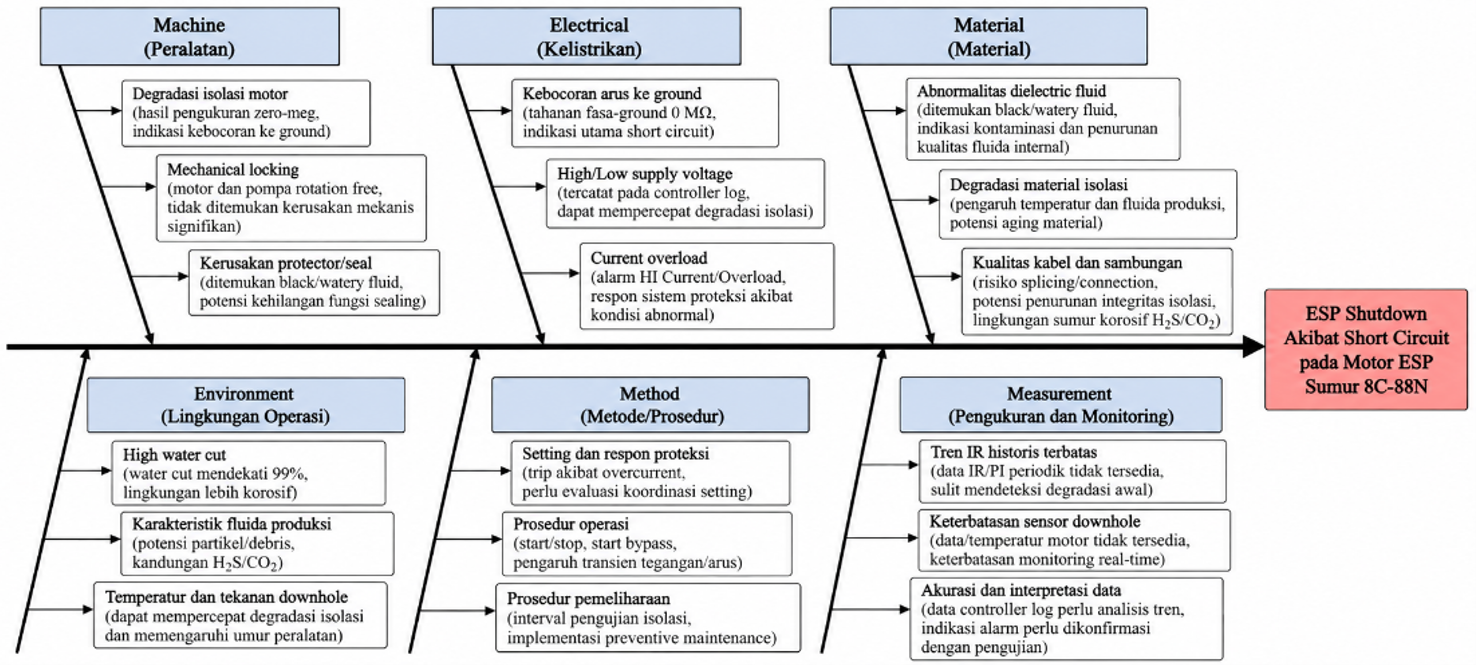
Penelitian ini mengkaji gangguan kelistrikan pada sistem Electrical Submersible Pump (ESP) tiga fasa di Sumur 8C-88N, Lapangan Minas, PT Pertamina Hulu Rokan. Penelitian dilakukan menggunakan pendekatan studi kasus deskriptif dengan memanfaatkan data riwayat sumur, desain ESP, catatan produksi, log pengendali, laporan penelusuran gangguan (troubleshooting), hasil pengukuran kelistrikan, serta catatan inspeksi pasca pengangkatan ESP. Diagram fishbone digunakan untuk mengelompokkan faktor-faktor yang berpotensi berkontribusi terhadap kegagalan, sedangkan Fault Tree Analysis (FTA) secara kualitatif digunakan untuk memetakan kemungkinan lokasi gangguan. ESP mengalami penghentian operasi pada 4 Januari 2026 dengan indikasi arus tinggi dan alarm beban lebih (overload). Hasil pengukuran setelah penghentian operasi menunjukkan nilai resistansi antarfasa yang relatif seimbang, yaitu sekitar 1,0 Ω, serta nilai resistansi isolasi fasa ke tanah sekitar 0 MΩ. Temuan tersebut paling sesuai dengan karakteristik gangguan fasa ke tanah pada rangkaian yang diuji, tetapi belum dapat mengidentifikasi komponen tempat gangguan bermula. Pompa dan motor dapat berputar bebas saat inspeksi pasca pengangkatan. Fluida berwarna hitam dan tampak berair yang ditemukan pada motor dan protector belum membuktikan adanya infiltrasi air. Catatan yang tersedia juga belum dapat menunjukkan urutan perubahan kondisi kelistrikan sebelum penghentian operasi. Pengujian setiap komponen secara terpisah dan sinkronisasi waktu pencatatan data operasi direkomendasikan untuk meningkatkan ketepatan identifikasi lokasi gangguan serta merekonstruksi urutan kejadian.
Downloads
References
[1] G. Takacs, Electrical Submersible Pumps Manual: Design, Operations, and Maintenance, 2nd ed. Gulf Professional Publishing, 2018.
[2] B. L. Wilson, Electrical Submersible Pump Analysis and Design, SPE Textbook Series, vol. 17. Society of Petroleum Engineers, 2012.
[3] A. Mubarak and H. Purwanto, “Analisis keandalan sistem Electrical Submersible Pump (ESP) menggunakan metode Failure Mode and Effect Analysis (FMEA) di lapangan minyak Kalimantan,” Jurnal Teknik Mesin dan Elektro, vol. 8, no. 2, pp. 101–113, 2020.
[4] M. Hagan and B. Petersen, “ESP system monitoring and surveillance: Best practices for maximizing run life in high-temperature environments,” Society of Petroleum Engineers, SPE-197087-MS, 2019.
[5] A. M. Berd and J. M. Guichon, “Insulation failure mechanisms in submersible motors operating under sour conditions: A laboratory investigation,” IEEE Transactions on Industry Applications, vol. 54, no. 4, pp. 3872–3881, 2018.
[6] Institute of Electrical and Electronics Engineers, IEEE Recommended Practice for Testing Insulation Resistance of Electric Machinery, IEEE Std 43-2013, 2013.
[7] Institute of Electrical and Electronics Engineers, IEEE Guide for Testing Turn-to-Turn Insulation on Form-Wound Stator Coils for AC Rotating Electric Machines, IEEE Std 522-2004, 2004.
[8] S. Handayani and B. W. Susanto, “Identifikasi jenis dan frekuensi kegagalan motor Electrical Submersible Pump (ESP) di lapangan minyak Indonesia,” in Prosiding Seminar Nasional Teknik Elektro 2020, pp. 112–121, 2020.
[9] R. Kurniawan and T. Suhendra, “Analisis kegagalan isolasi stator motor ESP menggunakan metode thermal imaging dan polarization index di lapangan minyak Riau,” ELECTRICIAN – Jurnal Rekayasa dan Teknologi Elektro, vol. 15, no. 1, pp. 45–55, 2021.
[10] M. F. Hidayat, A. B. Santoso, and R. D. Permana, “Penerapan root cause analysis (RCA) pada kegagalan motor ESP di lapangan minyak Pertamina EP: Studi kasus sumur high water cut,” Jurnal Energi dan Kelistrikan, vol. 14, no. 1, pp. 32–44, 2022.
[11] B. J. Kelley and R. D. Sherrill, “Diagnosis of motor failures from ESP teardown data: A statistical approach to root cause identification,” SPE Production & Operations, vol. 33, no. 3, pp. 589–600, 2018.
[12] H. Dunlap and E. Villamizar, “Comprehensive analysis of short circuit failures in ESP motors: Case studies and lessons learned from Latin American oil fields,” Journal of Petroleum Technology, vol. 72, no. 5, pp. 44–52, 2020.
[13] D. Firmansyah and A. Gunawan, “Evaluasi kualitas splicing kabel power ESP dan pengaruhnya terhadap keandalan sistem di lapangan minyak Kalimantan Timur,” Jurnal Teknologi dan Sistem Komputer, vol. 10, no. 1, pp. 45–54, 2022.
[14] W. T. Thomson and M. Fenger, “Current signature analysis to detect induction motor faults,” IEEE Industry Applications Magazine, vol. 7, no. 4, pp. 26–34, 2001.
[15] S. Vempati and B. Rapp, “Variable speed drive application and its effect on ESP system reliability: Field evidence from deepwater installations,” Society of Petroleum Engineers, SPE-190050-MS, 2018.
[16] R. K. Yin, Case Study Research and Applications: Design and Methods, 6th ed. SAGE Publications, 2018.
[17] American Petroleum Institute, Recommended Practice for the Operation, Maintenance, Surveillance, and Troubleshooting of Electric Submersible Pump Installations, API RP 11S, 4th ed., 2015.
[18] American Petroleum Institute, Electric Submersible Pump Teardown Report, API RP 11S1, 3rd ed., 2013.
[19] International Electrotechnical Commission, Rotating Electrical Machines—Part 1: Rating and Performance, IEC 60034-1, 2022.
[20] National Electrical Manufacturers Association, Motors and Generators, NEMA MG-1, 22nd ed., 2021.
[21] American Petroleum Institute, Recommended Practice for Sizing and Selection of Electric Submersible Pump Installations, API RP 11S4, 2nd ed., 2002.
[22] M. A. Usman, J. O. Ojo, and P. I. Obi, “Failure mode and effect analysis (FMEA) of electrical submersible pump in oil production: A quantitative approach,” International Journal of Engineering Research and Technology, vol. 11, no. 3, pp. 501–512, 2022.
[23] H. Pham and M. H. Tran, “Condition-based maintenance framework for ESP systems: Integration of real-time data, predictive analytics, and reliability engineering,” Journal of Petroleum Science and Engineering, vol. 198, Art. no. 108178, 2021.
Downloads
Published
How to Cite
Issue
Section
License
Copyright (c) 2026 Muhammad Ronald, Monice Monice

This work is licensed under a Creative Commons Attribution-ShareAlike 4.0 International License.
 Abstract views: 0
,
 PDF Downloads: 0