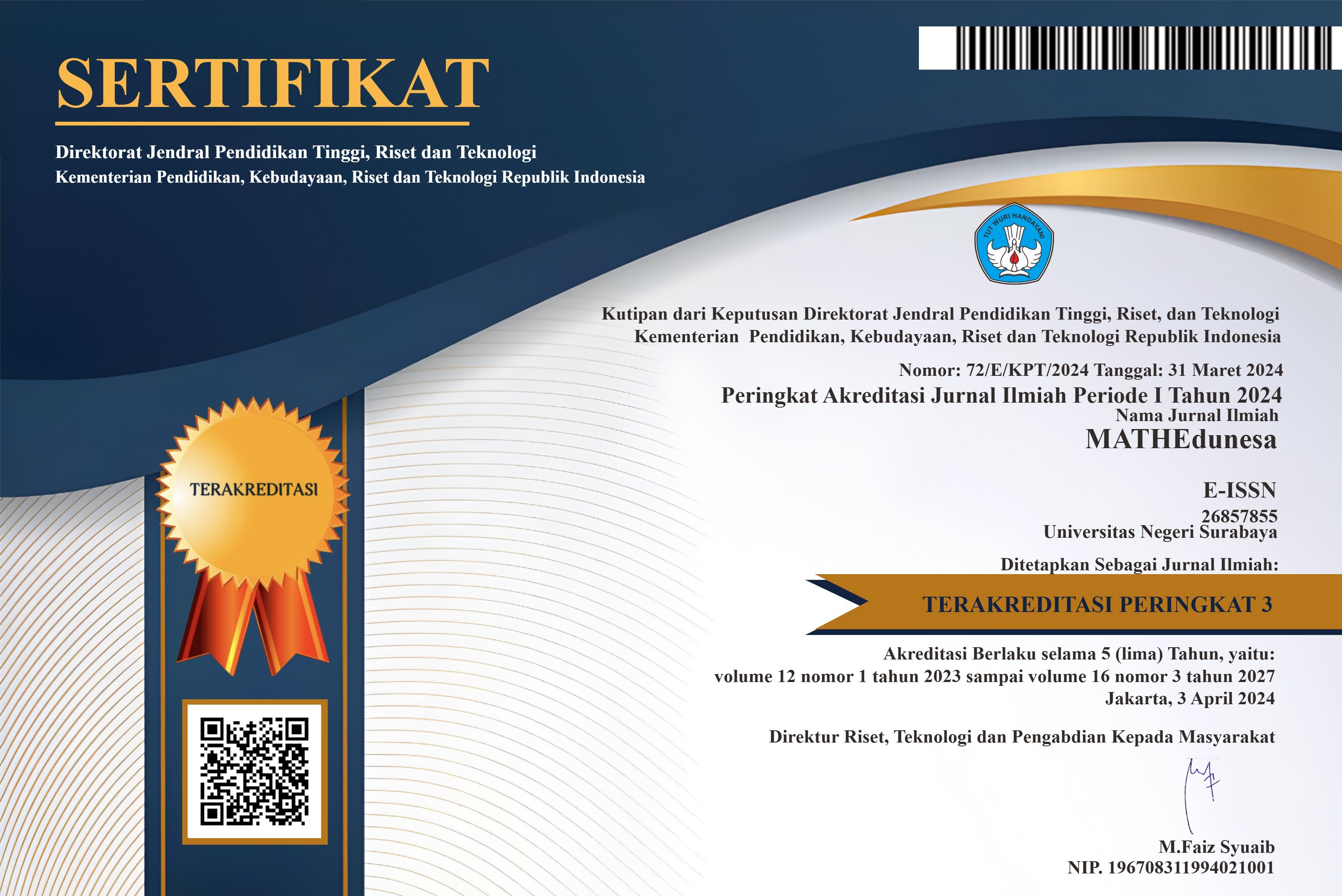
Kesalahan Siswa Madrasah Aliyah Negeri (MAN) dalam Menyelesaikan Soal Numerasi Setara AKM Ditinjau Disposisi Matematis
DOI:
https://doi.org/10.26740/mathedunesa.v16n1.p190-203Abstract
The low numeracy ability of Indonesian students has become a primary concern, reflected in the decline of the 2022 PISA score to 366 and national AKM data showing that less than 46.67% of students achieved the minimum competency. This condition results in a high tendency for students to make errors in solving numeracy problems, where mathematical disposition is identified as a factor influencing the types of errors made. This study aims to describe the types of errors made by MAN (Islamic Senior High School) students in solving AKM-equivalent numeracy problems viewed from mathematical disposition (high, moderate, low) based on Newman’s procedure. This study employed a qualitative approach. The research was conducted at MAN 2 Gresik with three 10th-grade students selected based on their mathematical disposition categories. Data collection techniques included a mathematical disposition questionnaire, an AKM-equivalent numeracy test, and interviews. Data analysis techniques involved analyzing the questionnaire using the Method of Successive Interval (MSI) for categorization, error analysis based on Newman's stages, and interview analysis. The results showed that: (1) students with high disposition committed errors in the transformation and encoding stages due to overconfidence; (2) stu dents with moderate disposition committed errors in the comprehension, transformation, process skill, and encoding stages due to the inability to integrate information; and (3) students with low disposition committed errors in almost all stages, particularly reading and comprehension, due to low self-efficacy. It is concluded that the level of mathematical disposition is related to the types of errors made by students. It is suggested that teachers implement differentiated learning strategies based on student disposition, and future researchers may develop instruments with more diverse contexts and examine interventions such as scaffolding.
Downloads
Downloads
Published
Issue
Section
 Abstract views: 23
,
 PDF Downloads: 27